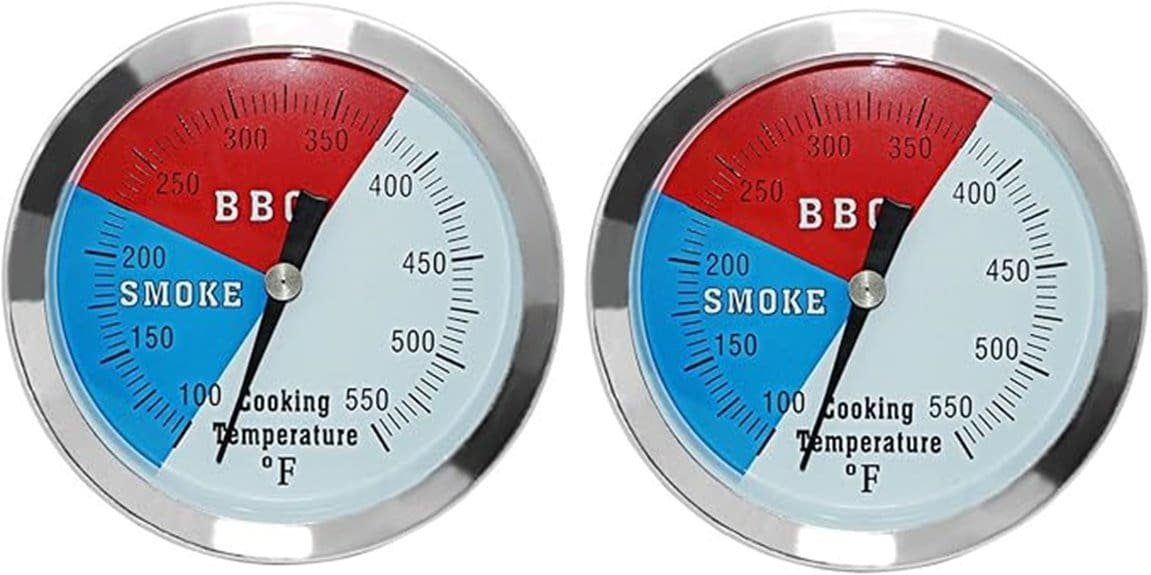
You’ll get a clear 3 1/8-inch dial that fits most 13/16-inch smoker ports (like Oklahoma Joe’s) and mounts from the outside to limit heat transfer. The 100–550°F scale, large numerals and three color zones make quick checks reliable, while the stainless probe stabilizes in about 3–4 seconds when inserted correctly. It’s weather-resistant and sturdy, though condensation can blur the face and it’s only for outer-mount use — keep going to see full installation, calibration and pros/cons.
Some Key Takeaways
- Large 3 1/8-inch dial gives quick, accurate reads from a distance with enlarged numerals and degree markings.
- 100–550°F scale suits most smoking and grilling tasks without clutter, with three color zones for instant context.
- Stainless-steel stem and outer-mount design fit 13/16-inch ports common on Oklahoma Joe’s and similar cookers.
- Probe stabilizes in about 3–4 seconds when inserted to proper depth; center placement in thick cuts yields best consistency.
- Durable, weather-resistant build resists rust, though condensation can temporarily blur the dial; calibrate against ice/boil if offsets appear.
Intent and Best Format: Quick Product Review for Buying Decisions
If you’re deciding whether this 3 1/8-inch BBQ thermometer is right for your smoker, focus on fit, readout clarity, and probe performance. You want a concise review that helps you decide quickly: mention mounting options, dial visibility, probe responsiveness, and build quality. State measured specs—dial size, temp range, probe length, response time—and note typical installation steps. Offer calibration tips briefly: compare to an ice bath and boiling point, adjust or replace if offset exceeds a few degrees. Keep tone cautious and evidence-based so you feel included in a practical community making informed buying choices. Consider mentioning meat thermometer basics to connect readers with essential buying guidance.
How the 3 1/8 BBQ Thermometer Gauge Fits Your Smoker or Grill
After weighing fit, readout clarity and probe performance, you’ll want to check how this 3 1/8-inch gauge physically mounts and reads on your cooker. You’ll find mount compatibility with Oklahoma Joe’s and most grills that use a 13/16-inch port; it’s intended for outer-mount installation. Confirm flange measurements and the included mounting kit to make certain a snug, vibration-free fit. The stainless-steel stem inserts through the hole and secures from the outside, minimizing heat transfer. Expect straightforward installation on smokers, charcoal pits and many grills, and join other cooks who prefer a reliable, evidence-backed fit. Many serious outdoor cooks prefer dedicated grill thermometer probes for accurate, repeatable readings when smoking and grilling.
Readability and Range: Dial Size, Color Zones, and Temperature Scale
Because the 3 1/8-inch dial gives you a larger visual field, you’ll read temperatures more quickly and accurately than from smaller gauges. The expanded face pairs enlarged degree markings with large font numerals, reducing squinting and easing group use. A 100–550°F scale covers most smoking and grilling needs without clutter. Three color contrast zones provide immediate context for low, cook, and high ranges, so you and others can glance and agree on status. Evidence-based layout and modest spacing lower misreads; be aware condensation can blur the dial temporarily, but visibility returns as fog dissipates. Many backyard grilling enthusiasts prefer gauges with clear markings and color zones to improve cook consistency and temperature monitoring.
Probe Performance and Measurement Accuracy in Real Cooking
Evaluating the probe’s performance in real cooking shows the 3-inch stainless steel rod delivers fast, reliable readings you’ll trust for everyday smoking and grilling. You’ll notice a fast response: internal temperatures stabilize within 3–4 seconds when inserted to proper probe depth, giving repeatable results across roasts and brisket point checks. Measurements align closely with reference thermometers in controlled comparisons, though placement matters—center of thick cuts yields best consistency. You can rely on this probe for routine monitoring, but always confirm placement and allow a few seconds for equilibrium to avoid misleading transient readings during active basting or heavy steam. Many grilling enthusiasts pair such probes with Bluetooth meat thermometers to monitor temps remotely and improve convenience during long cooks.
Durability, Installation, and Real-World Pros and Cons
While the thermometer’s stainless steel build gives it clear resistance to rust and wear, you’ll still want to install and maintain it properly to maximize lifespan. You fit the stem through the 13/16-inch hole, secure with included mounting hardware, and tighten to prevent wobble. The gauge shows reliable weather resistance for outdoor use, though repeated exposure to heavy steam can fog the dial temporarily. Pros: large readable face, quick probe response, sturdy construction that suits shared family cooking. Cons: possible condensation, limited to outer-mount applications. With routine checks and proper sealing, it serves most smokers and grills well. Many grill owners also keep a stock of essential replacement parts to ensure quick fixes and long-term performance.
Some Questions Answered
Is This Thermometer Oven-Safe for Indoor Use?
No — it isn’t explicitly oven safe. You should seek clarification and avoid prolonged indoor oven use without indoor safety testing. The gauge’s stainless steel construction and 100–550°F range suggest heat tolerance, but the outer-mount design, probe length, and sealed dial may not withstand oven conditions or high humidity. If you want to use it indoors, test cautiously at moderate temperatures and verify manufacturer guidance to guarantee safe, reliable performance and shared confidence.
Can I Calibrate the Gauge if It’s Off?
Yes — you can attempt calibration if it shows accuracy drift. Use a reliable ice-water (32°F) or boiling-water (212°F adjusted for altitude) calibration method to check readings. If the gauge is off, adjust the stem’s calibration nut (if accessible) or note the offset and compensate during use. Be cautious: some models aren’t user-adjustable; document your checks so you and fellow cooks can trust shared results and keep cooking consistent.
Does the Thermometer Resist Magnetic Interference?
No, it isn’t explicitly magnetically shielded, so you shouldn’t assume full resistance to magnetic interference. You’ll want to perform basic interference testing if you’re near strong magnets or electronics; keep magnets away from the stainless steel housing and probe during use. The construction reduces casual pickup, but it’s prudent to verify performance in your setup. If you find issues, reach out to the community — others may share mitigation tips and test results.
Is the Glass Lens Shatter-Resistant?
No — the glass lens isn’t marketed as shatter-resistant. You should assume some shatter risk if the gauge takes a hard hit; manufacturer specs note stainless steel durability but don’t cite impact testing for the lens. You’ll want to mount it carefully and avoid direct blows or heavy tools near the face. If you’re worried, consider added protection or a model explicitly rated for impact resistance so the whole crew stays confident.
Are Replacement Probes Available Separately?
Yes — replacement probes are available separately, though aftermarket availability varies by retailer. You’ll usually find compatible stainless steel probe rods sold online or through barbecue parts suppliers; check dimensions (3-inch stem, connection type) to ensure fit. Buy from reputable sellers and read reviews to confirm accuracy and response time. If you’re unsure, contact the seller for compatibility details so you’ll feel confident and included in the grilling community.